

Dismantling Defences: Counter Illicit Finance in Trump’s Second Administration
Tracking how the Trump administration is dismantling US and global anti-illicit finance systems.

Over the last six months, we’ve seen a flurry of legislative, regulatory, and institutional changes from the Trump administration. Some of these have encouraged the use of cryptocurrency; others have pulled back from long-standing anti-corruption efforts. And several have directly undermined the core capabilities of the US government to investigate and combat illicit finance.
Today, I’m launching a new initiative: Dismantling Defences: The Trump Illicit Finance Tracker.
This ongoing project will document and analyze the Trump administration’s efforts to weaken the US and international counter-illicit finance systems. This does not include Trump’s personal wealth projects (aka corruption) (Trump Coin, World Liberty, etc.), though those are also worth monitoring.
Instead, this is about institutions, enforcement, and influence.
Why This Matters
The US has long been the global driver of anti-money laundering (AML), counter-terrorism financing (CTF), counter-sanctions evasion/proliferation financing, and anti-kleptocracy efforts (broadly: counter-illicit finance). US law enforcement, financial regulators, and international partnerships have largely defined the rules—and enforced them. The counter-illicit finance fight is critical because all international security threats have a financial component. If we make it harder for bad people to do bad things with money, it makes it harder for them to achieve their objectives. When the rules are relaxed, bad actors take advantage of that and operate with impunity.
With the US taking a reduced role in countering illicit finance, countries will need to build new blocs and enforcement coalitions. They’ll have to develop capabilities that the US used to provide, including research, analysis, coalition building, diplomacy, coordinated sanctions, and more.
This tracker helps us understand what’s being dismantled—and what’s at risk.1
Below, you’ll find a list of recent (2025) policy actions that the Trump administration has taken that have a direct bearing on counter-illicit finance efforts in the US, and globally.
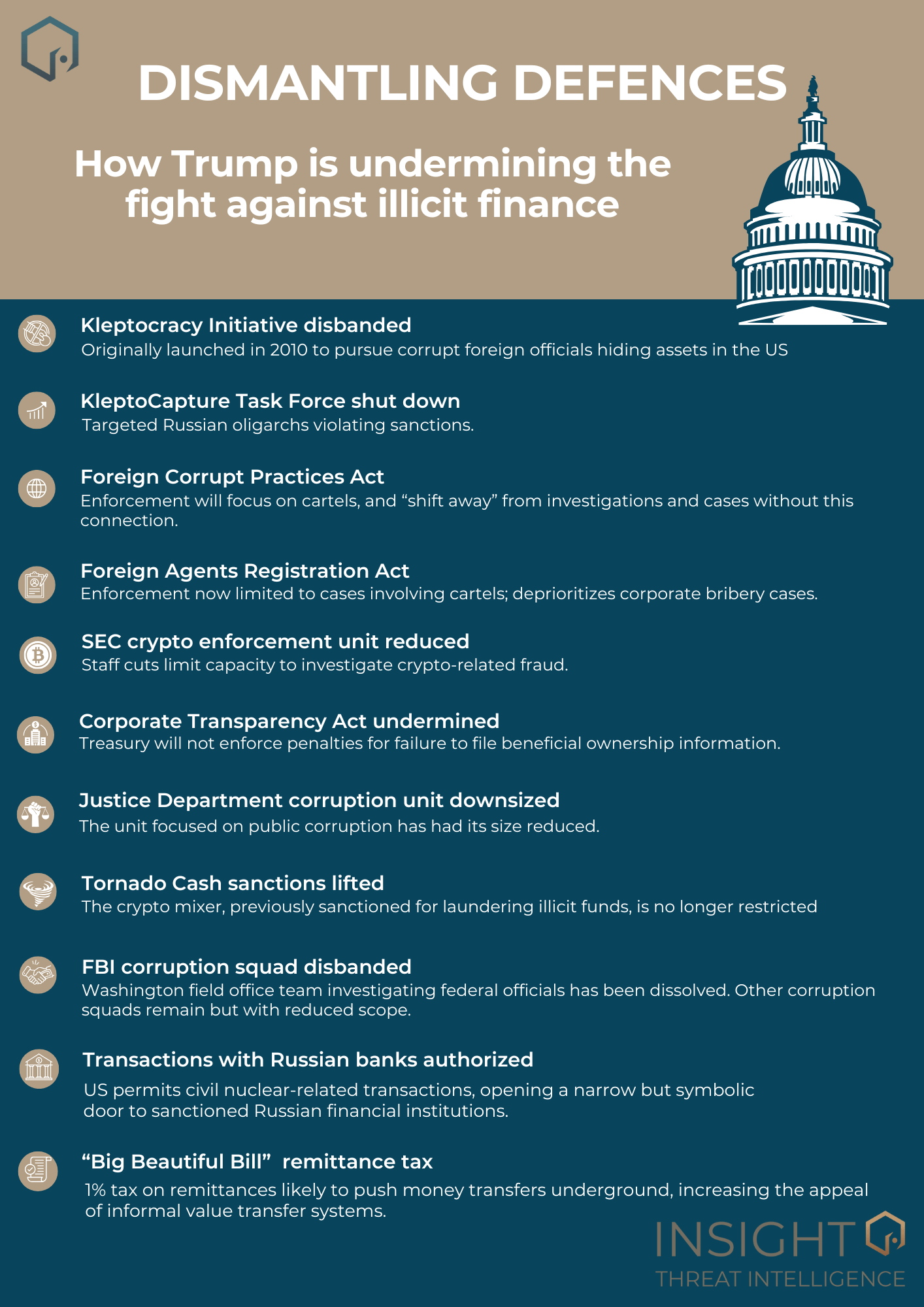
What’s at Stake
The weakening of oversight and enforcement mechanisms across multiple domains has created a permissive environment for illicit and destabilizing activities. Kleptocrats face fewer consequences when laundering money abroad, which emboldens corrupt regimes and undermines global anti-corruption efforts. Crypto laundering operations gain legitimacy and operational space, enabling illicit actors to move funds with reduced scrutiny. Foreign influence networks operate more freely amid lax enforcement, exacerbating the challenge of safeguarding democratic processes. Extremist financing networks and opaque ownership structures similarly evade scrutiny, complicating efforts to trace and disrupt flows of funds to high-risk individuals and groups. Meanwhile, public corruption investigations are hampered by the erosion of institutional expertise and the loss of critical investigative tools, diminishing the state's capacity to hold officials accountable. The global financial system is a network of countries with different regulations, and bad actors regularly take advantage of the weakest players on the board (those with the loosest regulations). Because of the size of the US economy and financial system and the dominance of the US dollar, the US is and will be (for the foreseeable future) a key node in the network. When the US steps back its fight against illicit finance, bad actors take note, and find vulnerabilities to take advantage of.
This isn’t just about the United States retreating from enforcement—it’s about creating a permissive global environment for illicit finance.
Financial Intelligence Fundamentals
Do you want to learn more about financial intelligence and how to use it in research, investigations, and analysis? Our financial intelligence fundamentals course is for you! This course is perfect for people new to financial intelligence and seasoned professionals. Enroll today

Stay Updated
Expect regular updates as this policy environment evolves. If you work in financial intelligence, compliance, regulation, or anti-corruption, this is a critical space to watch. The US may no longer be the enforcer it once was, and this will have major implications for the fight against illicit finance.
Insight Monitor is a reader-supported publication. To receive new posts and support my work, consider becoming a free or paid subscriber.
© 2025 Insight Threat Intelligence Ltd. All Rights Reserved.
This newsletter and its contents are protected by Canadian copyright law. Except as otherwise provided for under Canadian copyright law, this newsletter and its contents may not be copied, published, distributed, downloaded or otherwise stored in a retrieval system, transmitted or converted, in any form or by any means, electronic or otherwise, without the prior written permission of the copyright owner.
Sources: https://www.yahoo.com/news/trump-ag-disbanding-anti-corruption-000903041.html
https://www.documentcloud.org/documents/25514910-doj-eliminating-cartels/
https://home.treasury.gov/news/press-releases/sb0038
https://apnews.com/article/fbi-public-corruption-squad-trump-0478a9f5884b443e1f0403a1f6dad49e
https://www.cryptopolitan.com/trump-scales-back-crypto-enforcement/
https://www.occrp.org/en/news/provision-in-us-mega-tax-bill-could-boost-illicit-finance
https://www.justsecurity.org/110820/how-congress-can-stop-crypto-crash/
https://ofac.treasury.gov/media/934396/download?inline