

Obscuring the Money Behind the Bombs: New Data on Terrorist Financial Tradecraft
How terrorists are hiding the source, destination, and use of funds -- and what to do about it

Hello Insight Monitor subscribers, and welcome to another edition of our series on trends in terrorist financing, using a unique longitudinal dataset. This series goes beyond headline cases and anecdotes, offering data-driven insights and analysis you won’t find anywhere else. In this issue, I focus on how terrorists obscure the sources, destinations, and uses of funds—and what this reveals about terrorist financial adaptation.
Terrorist financing is often discussed in terms of how money is raised, but far less attention is paid to what happens next: how that money is deliberately hidden. In this context, obscuring refers to the financial tradecraft terrorists use to hide the source, destination, or ultimate use of funds—a set of practices designed to frustrate detection, complicate attribution, and sever the visible link between money and violence. Drawing on my existing dataset, this newsletter examines how terrorist groups and individuals disguise terrorist funds. Understanding these techniques is essential for a more operational understanding of how these networks and actors survive under sustained financial pressure.
To get caught up on the series so far (and learn more about the data, have a read:
Over the past six years, terrorists have demonstrably increased their use of financial tradecraft to obscure the source, destination, and use of funds. Importantly, the patterns observed in open cases and enforcement actions almost certainly represent a lower bound of actual tradecraft in use: the most sophisticated methods are, by definition, the least likely to be detected, investigated, or publicly documented.
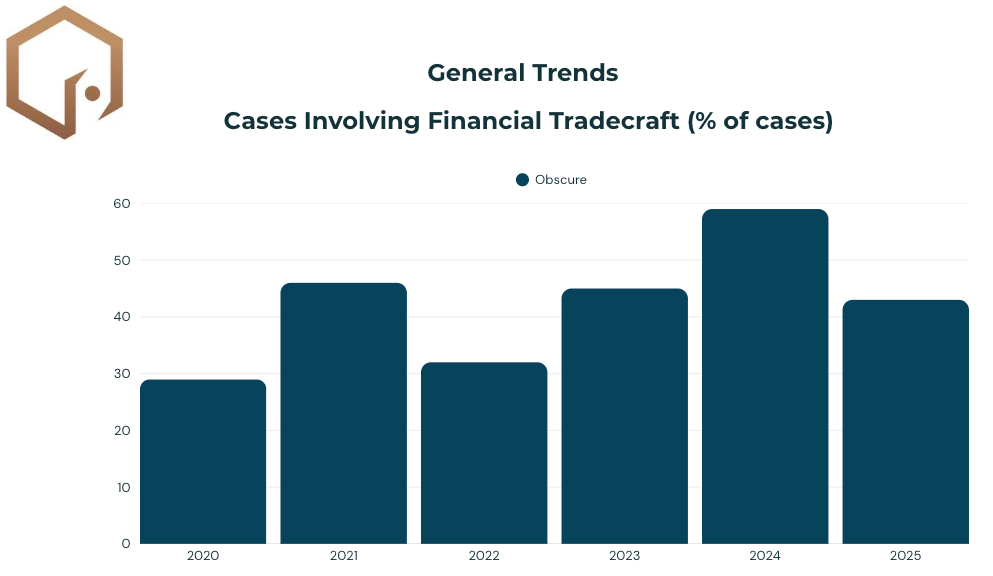
Over time, terrorist financing has become more complex, though it still generally lacks the sophistication typically observed in large-scale money laundering or other forms of illicit finance. This growing complexity is not driven by a single innovation, but by the layering of methods that, when combined, increase network opacity. These methods include continued reliance on cash, the use of facilitators and enablers, the deployment of third parties and proxies, and the selective adoption of money-laundering techniques. Keep reading to learn more:
