


Hello, Insight Monitor subscribers! I’m excited to share a new product with you today — our analysis of terrorist financing trends. I often get asked, “What’s new?” in terrorist financing? I struggle to answer because I don’t want to refer to headlines. I prefer my answers to be data-driven. If you feel the same way, today, you’re in luck! We crunched the numbers, and we can tell you ~exactly~ what’s new in terrorist financing. Have a read and let me know what you think in the comments or through email. We love hearing from you, and would be delighted to answer any questions you have about this. Thanks for caring about illicit finance and global security,
~Jess
Establishing a baseline
Since 2018, I’ve captured terrorist financing “cases” from media reports, court cases, government press releases, and other open sources. These are incidents of terrorist financing that refer to operational or organizational financing. In each case, we look for financing attributes, such as the methods and mechanisms involved in raising, using, moving, storing, managing, and obscuring funds. This builds on the data and analysis from my 2021 book Illicit Money.
Over the last six years, I’ve identified 618 terrorist financing cases that are now included in this dataset. As you can see in the graph below, data collection in 2018 and 2019 was still spotty. We instituted new data collection practices in 2020, so things took off then, and the data is robust from 2020 onwards.

There is an apparent dip in terrorist financing cases in 2021 and 2022. This is interesting because it mirrors a similar dip in FINTRAC terrorist financing disclosures that we attribute to the pandemic. Or was there just less terrorist financing? Or less reporting on it? Many intervening factors are likely to explain this, but it is interesting to see global terrorist financing cases largely mirror FINTRAC disclosure trends.
Is Canada giving up on tackling terrorist financing?

It’s the most wonderful time of the year! FINTRAC’s annual report dropped last week. Okay, I’ll admit that I’m probably the only one that excited about this report. But for those of you who don’t know, this report is one of the most transparent descriptions of the activities of a department or agency in the Canadian security and intelligence service. And while I’m often annoyed about our lack of measurements in the anti-money laundering and counter-terrorist financing world, this report at least gives us ~some~ insight. Read to find out how Canada is doing in its fight against money laundering, terrorist financing, and other financial crimes!

Our terrorist financing analysis course caters to researchers, intelligence, law enforcement, and compliance professionals to help them learn about terrorist financing and analyze suspicious patterns and activities more effectively. Sign up today!
New trends
Over the last 4+ years, the primary methods that terrorists use to raise funds are through charitable causes (but not necessarily through charitable organizations; I make the distinction here), taxation and extortion, and through businesses and investments. When they use money, they are primarily using it for attacks, weapons, and components, but also for training and social services and sustenance. Terrorists are now mainly moving money through cryptocurrencies (a significant development I’ll say more about below), banks, and money service businesses. Terrorists store funds in banks and cash and manage that money through multiple managers and professional enablers. Finally, they hide the source and destination of funds through professional enablers, online procurement, and third parties.
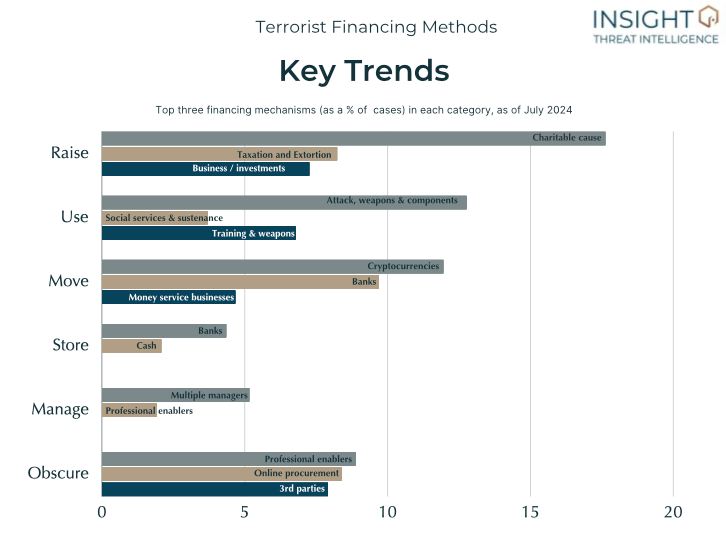
Three main trends stand out to me from this analysis: the use of charitable causes to raise money, the use of cryptocurrency to move funds and value, and the use of professional enablers to hide the source and destination of funds (and also to manage that money).
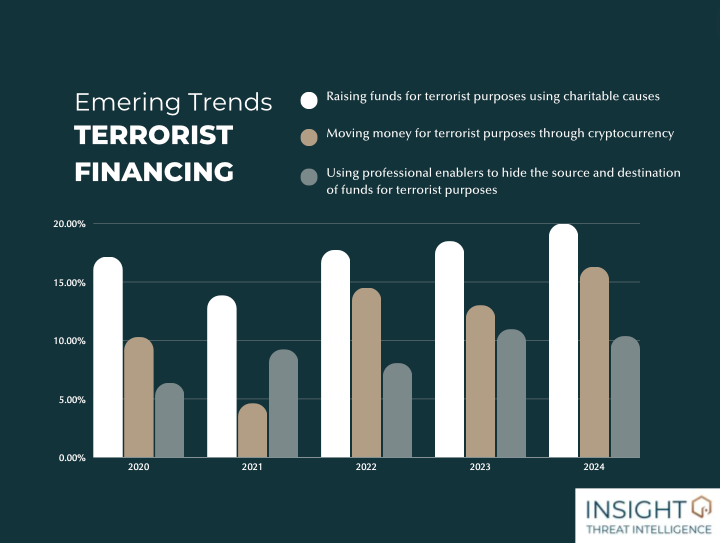
Over time, the prevalence of all three of these mechanisms has increased in terrorist financing cases. The use of charitable causes refers to informal crowdfunding campaigns where a charitable cause is used to solicit funds, but money never goes through a charity. Instead, funds are usually sent through PayPal or other forms of sending money. It can also include formal crowdfunding campaigns using crowdfunding platforms but without the involvement of a charitable organization. Several organizations have written about the rise of crowdfunding for terrorist financing, and this is a similar trend, although it uses a charitable cause as a “cover story” for the collection of funds.
The cryptocurrency era
The increase in cryptocurrency as a method of moving funds is particularly interesting. Cryptocurrency has now surpassed the use of banks in terrorist financing cases. However, that does not mean that all terrorist financing is happening through crypto: crypto was present in only about 12% of terrorist financing cases between 2020 and 2024.
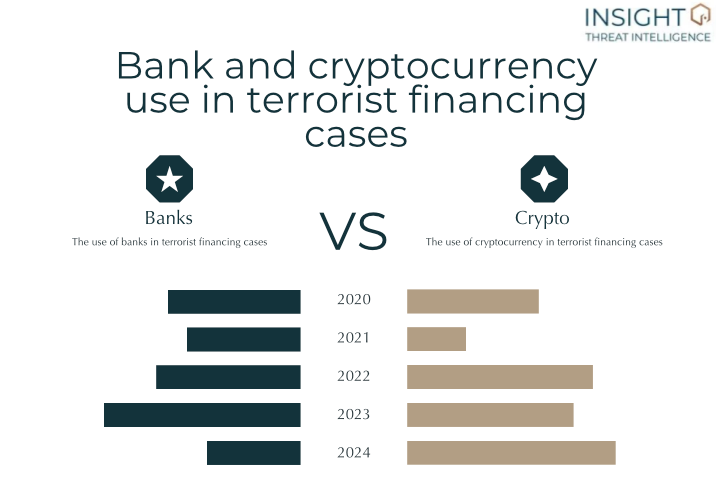
Terrorists still use many other methods of moving funds, but crypto has become the primary identified method. There are two explanations for this finding. The first is that cryptocurrency use among terrorists has been increasing. We’ve noted this for several years now. The second is that when terrorists use cryptocurrency, it is ~much more~ likely to be reported than when they use banks or hawala. Cryptocurrency is exciting and divisive and gets a lot of attention, so it gets reported.

Finally, the last trend is the most interesting. The use of professional enablers in terrorist financing cases has increased significantly over the previous few years but has received relatively little attention. The use of these enablers (think lawyers, accountants, bankers, and other professionals) has been a growing trend in money laundering cases for a long time. But their presence in terrorist financing cases surprises me. It challenges my assumption that terrorist financing tends towards simplicity. Instead, this might indicate that terrorist financiers are increasingly professionalizing their activities and are adapting to counterterrorist financing efforts by using these services.
I hope you found that data-drive analysis of terrorist financing trends interesting and useful. If you liked it, let me know in the comments or by dropping me a line. It’ll help make sure that we update this again soon. It’s on our schedule again for December / early January (there will always be a short data lag as we collate our information!), and I look forward to sharing updates with all of you.
© 2024 Insight Threat Intelligence Ltd. All Rights Reserved.
This newsletter and its contents are protected by Canadian copyright law. Except as otherwise provided for under Canadian copyright law, this newsletter and its contents may not be copied, published, distributed, downloaded or otherwise stored in a retrieval system, transmitted or converted, in any form or by any means, electronic or otherwise, without the prior written permission of the copyright owner.