

Why global statements on terror finance set us up for failure
Or: why I hate the "No Money for Terror" conference
I have a big problem with the “No Money for Terror” conference: it creates the conditions for failure.
But first: next week, my friend and colleague Stephen Reimer will go live on Substack to share our latest insights, research, and, of course, gripes, on terrorist and counterterrorism financing. It promises to be a lively discussion, as Stephen and I have much to catch up on. You can sign up here:
The “No Money for Terror” conference (NMFT) was the brainchild of French President Emanuel Macron, and first took place in 2018. Since that time, there have been meetings in Australia in 2019, New Delhi in 2022, and Munich in 2025. After every conference, communiques and press releases are issued with varying degrees of lucidity. Inevitably, they call on states to implement the FATF recommendations fully, and sometimes call on the FATF to take specific actions.
This is not unusual, as this conference stems from the G7 process. These meetings tend to result in negotiated statements. That’s not to say that these processes are toothless. They set high-level policy objectives that get translated into FATF action, state legislation, and much more, over long periods of time.
That’s not my problem. My problem is the maximalist objectives the conference and related press releases invite.
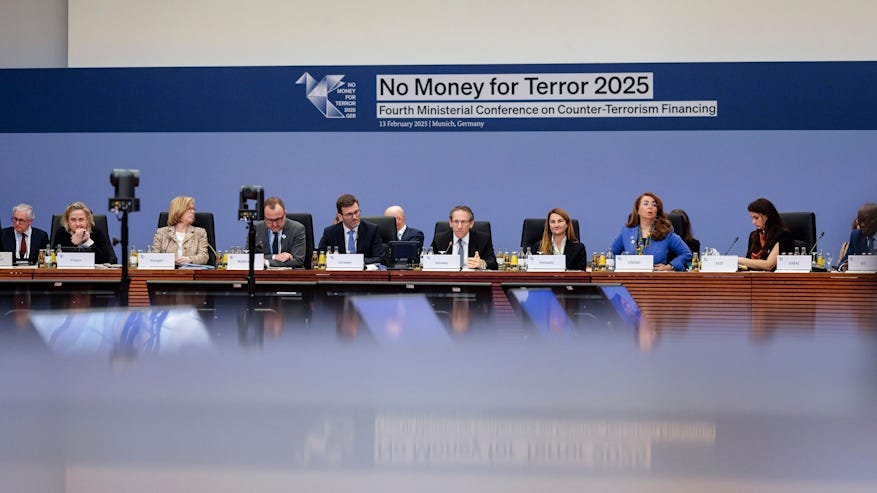
The very title of the conference invites criticism: “no money for terror". Further, following this year’s conference, the FATF President said: "We need to work decisively, and collectively, to cut off the financial blood supply to terrorists."
These are impossible tasks and statements like this set up the entire CTF regime for failure.
Now, you might think that I’m nitpicking here, and perhaps I am. But these are the statements against which success is measured. If the policy outcome is “no money for terror” or “cut off the blood supply to terrorists”, this implies that anything less than total elimination of terrorist financing is a failure.
The larger problem, of course, is that the goals of counter terrorist financing have always been either really grandiose or ill-defined. This is something that my next book deals with in detail. Part of the problem starts with how we define counterterrorist financing. I address this at length in my Terrorism and Political Violence article, available here. I broadly define CTF as a combination of policies and tools that can be broadly grouped together according to these categories:
(1) The criminalization/policing of terrorist financing criminalizes terrorist financing activities at the international and domestic level;
(2) The intelligence approach creates and exploits financial intelligence and financial surveillance;
(3) The military approach conducts targeted strikes, prevents control of territory, and captures or kills key individuals;
(4) The financial exclusion approach creates international and domestic sanctions, asset forfeiture and seizure;
5) The private sector/regulatory risk approach downloads responsibilities for CTF to the private sector and requires mandatory reporting and participation in CTF regimes;
(6) The technical assistance approach draws on the above practices and seeks to increase the capacity of states to implement these other approaches;
(7) The civil law approach uses civil lawsuits to restrict terrorist actors’ access to funds and degrade their future capabilities; and
(8) The financial deplatforming approach uses platform terms of service to deny access to individuals and entities and limit their ability to fundraise.
Taken together, these are all the tools and policies that constitute “CTF”. None of these, on their own, constitutes a CTF strategy. To have a good CTF strategy, these tools need to be selected and adapted according to specific threats, and more importantly, coordinated with international partners. (Terrorist financing is an international problem, not a domestic one, and it necessitates international cooperation.)
Critically, none of these tools will ever end terrorist financing. They will add friction. They will reduce the amount of money available for terrorism. But stop terrorist financing? I wish.
If we want to evaluate CTF outcomes, we have to evaluate each and every one of these tools and policies, determine whether, when, and how they ‘work’ (defining “work” is also important), and how they can be improved. But we should not measure them against an impossible yardstick.

Our terrorist financing analysis course caters to researchers, intelligence, law enforcement, and compliance professionals to help them learn about terrorist financing, and analyze suspicious patterns and activities more effectively. Sign up today!
Back to the Conference….
Anyway, back to the NMFT statement. The statement identifies three priority areas for counterterrorist financing efforts:
Misuse of financial innovations for terrorist financing: terrorists are using virtual assets and digital payments, and investigations involving these assets are difficult. Terrorist financing also uses crowdfunding and social media and messaging apps. The NMFT communique calls on states to enforce FATF standards, to address gaps in regulating stablecoins and unhosted wallets, and to enforce the travel rule.1
Territorial control: including the capture of state funds by terrorists, ransom payments, and transnational nodes and facilitation networks. This is increasingly a problem in Africa, and specifically in Mali, with the expansion of JNIM’s activities.
Terrorism and organized crime: noting how terrorists use crime to raise money, and that some organized crime groups meet the legal threshold for listing as terrorist entities, and that some terrorists are providing crime-as-a-service (a likely reference to the Com network).
I don’t have a problem with any of these priorities; they are, in fact, huge problems in the world of terrorist financing. This covers pretty much all the highlights and is a focused list to engage the FATF and international partners.
It’s all well and good until someone suggests that we stop the flow of funds to terrorists or give no money for terror.
Maybe we can just agree on “less money for terror”? And less terrorism in general? What do you think? Join our live to have your say next week.
© 2026 Insight Threat Intelligence Ltd. All Rights Reserved.
This newsletter and its contents are protected by Canadian copyright law. Except as otherwise provided for under Canadian copyright law, this newsletter and its contents may not be copied, published, distributed, downloaded or otherwise stored in a retrieval system, transmitted or converted, in any form or by any means, electronic or otherwise, without the prior written permission of the copyright owner.
The travel rule is a regulation that requires financial institutions, including virtual asset service providers, to share information about the sender and receiver during fund transfers.