

Iranian funding of Hamas through Cryptocurrency
Part 3 of our axis of illicit finance series

Hello, Insight Monitor subscribers, and welcome to part 3 of our series on Iran’s use of cryptocurrency to finance its sanctions evasion activity and the axis of illicit finance.
In part 1 of this series, we explained the Iran sanctions context and how Iran began widespread use of cryptocurrency in 2018, largely as a response to those sanctions. We highlighted Iran’s role in mining Bitcoin, which creates liquidity for the regime while also leveraging its oil surplus.


In part 2 of the series, we explored how Iran uses cryptocurrency to finance the Houthis (Ansarallah). We illuminated the various companies, exchanges, and individuals involved in Iran-Yemen crypto threat finance, highlighting the many jurisdictions this network spans.

«in part 3 of the series…»
Today, we’re looking at the role of Iran’s illicit crypto finance network in financing Hamas. Hamas is part of Iran’s Axis of Resistance and has been funded by the regime to the tune of $100 million per year. While much of this is provided to Hamas through cash couriers, hawala transfers, and trade-based financing mechanisms, some of it is provided through cryptocurrency transactions.
Hamas’s relationship with cryptocurrency is an interesting one. The group was an early adopter of cryptocurrency, soliciting donations on its public website almost a decade ago. Hamas has used cryptocurrencies such as Bitcoin and stablecoins to store and transfer funds, and has raised hundreds of thousands (if not millions) by soliciting cryptocurrency donations from its members and supporters worldwide. To conceal the origin and final destination of cryptocurrency transactions, the Qassam Brigades’ website offered instructions in multiple languages on creating Bitcoin wallets and making untraceable donations to Hamas. To further enhance anonymity, Hamas also generated unique transaction links for individual Bitcoin wallets on its website, avoiding cryptocurrency exchanges that are more susceptible to tracking by authorities.
Hamas has not had complete freedom to operate in the cryptocurrency market. In June 2021, Israel’s National Bureau for Counter-Terrorist Financing (NBCTF) seized multiple cryptocurrency wallets linked to a Hamas fundraising campaign, some associated with the Qassam Brigade. One of these wallets belonged to Buy Cash Money and Money Transfer Company, a Gaza-based business providing money transfer and virtual currency exchange services. Buy Cash facilitated fund transfers for not only Hamas but also affiliates of other terrorist groups, such as Al Qaeda and ISIS. However, this was not the end of Hamas’s use of cryptocurrency. While Iran has a number of different means to move money to Hamas, the IRGC has also used cryptocurrency to fund the group.
In April 2023, Israel’s NBCTF seized 189 cryptocurrency accounts that were associated with three Palestinian currency exchanges, including Gaza and Türkiye-based exchange Al-Markaziya Li-Siarafa, which Israel designated for its support for Hamas. This exchange, previously known by a different name (Al-Mutahadun for Exchange), is alleged to be directly involved in facilitating tens of millions of dollars from the IRGC-QF to Hamas and Palestinian Islamic Jihad (PIJ). Al-Markaziya is owned by Zuhair Shamlakh, a Gaza-based money changer. He is alleged to have used a network of exchanges that sent digital tokens to operators abroad to settle hawala balances, as well as to wallets controlled by Hamas-affiliated money exchanges. Around 2020, this method of transfer became a central part of Hamas’s operational financial activity.
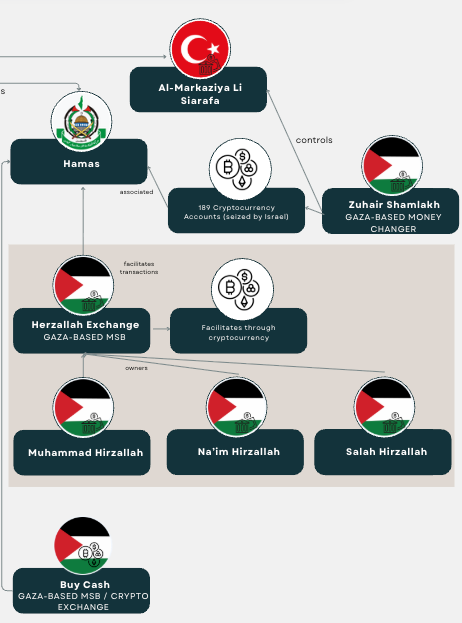
Another known Hamas financing network is the Herzallah network. This network is centered on the Gaza-based Herzallah Exchange and General Trading Company LLC, which has worked with Hamas to facilitate transactions through cryptocurrencies and has laundered funds for Hamas and PIJ. The exchange is owned by Muhammad Fallah Kamil Hirzallah, Na’im Kamil Raghib Hirzallah, and Salah Kamil Raghib Hirzallah. While there are no publicly identified transactions from Iran moving through this exchange, this remains a possible avenue for Iranian crypto funding of Hamas.
Financial Intelligence Fundamentals
Do you want to learn more about financial intelligence and how to use it in research, investigations, and analysis? Our financial intelligence fundamentals course is for you! This course is perfect for people new to financial intelligence and seasoned professionals. Enroll today

The attribution of wallets and the transactions moving through them is complicated. In some cases, wallets are wholly attributed to the IRGC even when they are used by multiple entities. In one case, the NBCTF designated two hot wallets used by the IRGC. Even though other (non-IRGC) funds likely moved through those wallets, the entire set of wallets was designated by Israeli authorities. When this type of action is reported by the media, it can lead to exaggerated estimates of terrorist financing, as the nuances of wallet control and use are sometimes lost, and all funds that have flowed through those wallets are incorrectly “attributed” to the IRGC. In reality, these wallets often represent informal exchanges, over-the-counter brokers, or hawalas, meaning that they serve a diverse set of clients, not just Hamas or other terrorist groups. As such, describing all the transactions flowing through the wallets as “terror finance” is misleading.
While there is evidence of direct cryptocurrency transactions between Iran-linked wallets, facilitators, and Hamas, transactions appear to have largely passed through informal exchanges or hawaladars providing cash-out services, making the scale of this activity difficult to quantify. Historically, Iran’s support to Hamas has primarily moved through cash couriers into Gaza, as well as other types of transactions to deposit funds into the group’s wider financial networks abroad.
However, with recent disruptions to traditional supply routes, Iran could increasingly turn to cryptocurrency to facilitate transfers. The change in regime brought about by the Iran-US-Israel war has removed significant layers of older regime members; the newer, younger leaders are likely to more fully embrace cryptocurrency as a means of transferring funds to its proxies, including Hamas. At the same time, Israel’s focused targeting of financial facilitators in Gaza has likely constrained the effectiveness of any such efforts, leaving the future role of cryptocurrency in Hamas’s financing both fluid and uncertain.
This research is part of my post-doctoral work funded by the University of Calgary’s Faculty of Law.
© 2026 Insight Threat Intelligence Ltd. All Rights Reserved.
This newsletter and its contents are protected by Canadian copyright law. Except as otherwise provided for under Canadian copyright law, this newsletter and its contents may not be copied, published, distributed, downloaded or otherwise stored in a retrieval system, transmitted or converted, in any form or by any means, electronic or otherwise, without the prior written permission of the copyright owner.